
Trade
rivalries between China
and the United States are well known, but there is a competition heating up that, though often overlooked, is perhaps even more crucial.
Setting standards for
emerging technologies
has historically been dominated by the United States, Germany and Japan, and these countries have reaped the profits, said Angelo Katsoras, National Bank of Canada’s geopolitical analyst, in a report.
When a country’s companies set standards in a sector they gain a competitive advantage and generate billions in licensing fees and
intellectual property
rights.
IBM Corp.
, for example, which holds 100,000 patents, earned $366 million last year from IP licensing, said Katsoras.
“Setting the next generation of global technology standards is not just a technical contest; it is also a strategic battle with significant geopolitical ramifications,” he said.
“The country that comes out on top will gain disproportionate influence over how key emerging technologies are governed, effectively compelling other nations to follow their lead in these sectors for many years to come.”
China officially launched its China Standards 2035 strategy in 2018, an action plan to establish the country as a global leader in the development of emerging-technology standards, including
artificial intelligence
.
Evidence of its growing presence in this sphere is apparent on the organizations that oversee international standards. Up until recently the U.S. assumed their dominance in these bodies was secure, but China has steadily been gaining influence.
Over the past two decades the country has expanded its leadership roles on the influential International Organization for Standardization from 21 to 373, overtaking Japan, France and the United Kingdom.
In a sign of China’s growing influence in the International Telecommunication Union, which develops standards for everything from radio frequencies to 6G mobile networks, three new technical standards approved last year for integrating AI into 6G networks were developed by the Chinese Academy of Sciences and China Telecom.
China is also gaining on the patent front, said Katsoras. While Google still tops the generative AI patent race, universities and state-owned companies in China are keeping up with American giants such as
Microsoft Corp.
,
Nvidia Corp.
and IBM.
While American companies up until now have focused on developing AI models that are proprietary, China has focused on open-source AI systems, particularly in developing countries.
“China’s long-term goal is to transform the specifications of its leading open source AI models into global industry standards,” said Katsoras.
And they are gaining ground. With 910 million downloads,
ChatGPT
is the world’s leading consumer AI chatbot, compared to the 125 million of China’s
DeepSeek
. But China has now overtaken the United States in the total number of downloads of its open-sourced AI models.
So great was their success that AI global leader
OpenAI
had to shift strategy and release its own open-source version.
“It was clear that if we didn’t do it, the world was going to head to be mostly built on Chinese open-source models,” said OpenAI CEO Sam Altman at the time.
Not only is China developing the technology it is also supplying the infrastructure to support it, said Katsoras.
Huawei
and ZTE have become major suppliers of data centre equipment, 5G wireless systems and fibre optic cables particularly in developing nations, offering their products at much lower prices than Western countries.
Last year, China became the world’s largest producer of industrial robots, overtaking Japan.
What further complicates matters is that rising geopolitical tensions are splitting the world in two, with separate standards arising across regions.
“Consequently, more and more, the standards a country adopts and the products to which it grants market access are being dictated by its geopolitical alignment — whether with China or the United States,” said Katsoras.
Sign up here to get Posthaste delivered straight to your inbox.

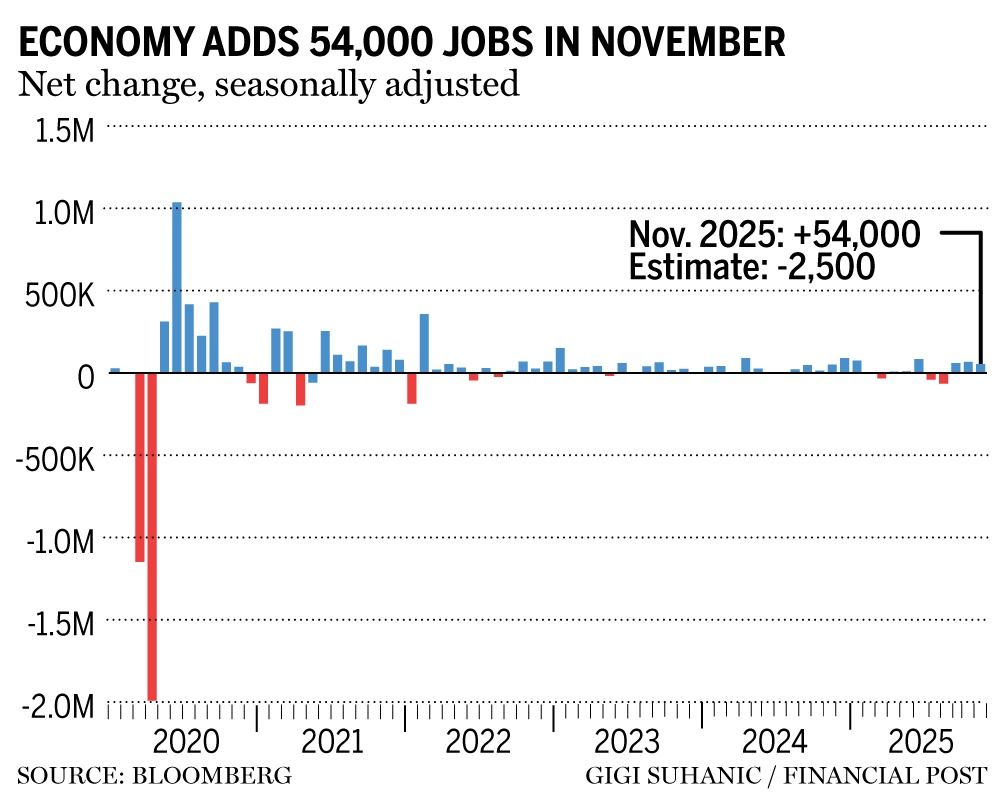
Canada’s jobs report walloped expectations so soundly Friday that one observer quipped that the Bank of Canada might be tempted to hike rather than cut interest rates this week.
Canada gained 54,000 jobs
in November, while economists had predicted the loss of 2,500 positions. The unemployment rate fell to 6.5 per cent, when the consensus was for it to rise to 7.
The solid jobs report, which follows a series of forecast-beating economic data, “quashes any lingering prospect of a near-term Bank of Canada rate cut,” said Douglas Porter, chief economist at BMO Capital Markets.
Markets are now considering the possibility of rate hikes in 2026, but BMO thinks that would be premature. However, the odds of further cuts next year has been seriously reduced, he said.

- Air Transat will start canceling flights today and on Tuesday after the union representing the airline’s 700 pilots issued a three-day strike notice.


- How a ‘bleak’ job market is pushing white-collar workers to train AI that could one day replace them
- What the $83-billion Netflix-Warner Bros. deal could mean for Crave and Canadian streaming
- Big Six bank bonuses climb on dealmaking profits despite uncertain economy

Lars and Anna, newly retired, are in a stronger financial position than they realize. Family Finance runs the numbers on the Northern Ontario couple’s current investments and finds that their net worth could rise from $1,750,000 to well over $5,000,000 in 30 years.
Read more

Interested in energy? The subscriber-only FP West: Energy Insider newsletter brings you exclusive reporting and in-depth analysis on one of the country’s most important sectors.
Sign up here.
McLister on mortgages
Want to learn more about mortgages? Mortgage strategist Robert McLister’s
Financial Post column
can help navigate the complex sector, from the latest trends to financing opportunities you won’t want to miss. Plus check his
mortgage rate page
for Canada’s lowest national mortgage rates, updated daily.
Financial Post on YouTube
Visit the Financial Post’s
YouTube channel
for interviews with Canada’s leading experts in business, economics, housing, the energy sector and more.
Today’s Posthaste was written by Pamela Heaven with additional reporting from Financial Post staff, The Canadian Press and Bloomberg.
Have a story idea, pitch, embargoed report, or a suggestion for this newsletter? Email us at
.
Bookmark our website and support our journalism: Don’t miss the business news you need to know — add financialpost.com to your bookmarks and sign up for our newsletters here
,
#Posthaste #China #gaining #ground #crucial #power #struggle #people #don039t #exists

0 Comments