
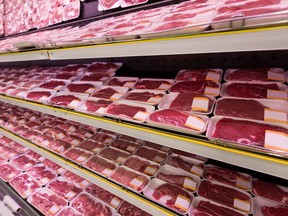
Food inflation is climbing faster than overall inflation — and it may soon become a political problem.
Article content
The cost of living is worse than it’s ever been: That’s the view of 67% of Canadians, according to an Abacus Data poll.
Advertisement 2

Article content
The news from Statistics Canada on Monday morning won’t help with that feeling as grocery prices spiked yet again just before Christmas.
Article content
Article content
The latest inflation report from StatsCan shows core inflation rose 2.2% in November; food inflation, though, rose 4.7% for what we pay stores as opposed to restaurants.
“Prices for food purchased from stores rose 4.7% year over year in November after increasing 3.4% in October. The increase in November was the largest since December 2023,” StatsCan’s report said.
Year-over-year spikes in key food categories raise concern
The increase in some food categories was nothing short of shocking.
In November, prices for fresh or frozen beef (up 17.7%) and coffee (up 27.8%) continued to be significant contributors to overall grocery inflation on an annual basis,” StatsCan said.

Your Midday Sun
Article content
Advertisement 3
Article content
Is it any wonder that the voting public sees the cost of living as one of the most pressing issues, above health care, above jobs and the economy, above anything else. While 67% tell Abacus that the cost of living “is the worst I can remember,” those saying it should be the top priority for government stands at just 62%.
Recommended video

We apologize, but this video has failed to load.
That’s still 22 points ahead of health care which comes in at the number two spot for top priorities. Abacus Data CEO David Coletto wrote that the concern about affordability crosses generational and party lines – especially in the area of grocery prices.
“The most widely cited concern is grocery prices, selected by 81% of Canadians. This concern rises sharply with age, from 61% among those aged 18 to 29 to 93% among those aged 60 and over. Food prices are the most universal and emotionally resonant cost because they are unavoidable and visible every week,” Coletto wrote.
Advertisement 4
Article content
Climbing grocery prices push Canadians toward cheaper proteins
Who can handle beef prices rising by 17.7%, compared to last year, or coffee going up 27.8%. These are basics, staples of the Canadian diet and while there is a turn towards other protein sources like pork or chicken, that is putting upward pressure on the prices of those meats.
“Because of beef prices, people are starting to pivot towards chicken and, and pork. And we’re expecting those two other components to become more expensive,” said Dr. Sylvain Charlebois, a professor in agriculture at Dalhousie University who is known as the Food Professor.
Food inflation expected to keep rising in 2026, report warns
Just about two weeks ago, Charlebois released Canada’s Food Price Report, the annual prediction of where food prices will go in the next year. He and his team predict that an average basket of groceries in 2026 for a family of four will cost around $17,500, an increase of up to $994, compared to 2025.
Advertisement 5
Article content
Charlebois was blunt; the rising prices at the grocery store have nothing to do with grocery store owners trying to gouge anyone.
“Our food inflation problem is structural,” Charlebois said.
Policy failures, logistics and carbon pricing contribute to higher costs
Asked to list off what structural problems are adding to food inflation, he provided a long list — bad logistics, supply management, carbon pricing, inter-provincial trade barriers, taxation and fiscal policies. While he said none of these issues are the sole reason for persistently high food inflation, they do all contribute to our increasing cost of living.
Over the past five years, the cost of groceries in Canada have jumped more than 27%, well above the 20% overall inflation rate over that same five-year period.
Advertisement 6
Article content
Canadians are concerned about the increasing cost of living for very valid reasons. The increase in the cost of living is rising. On the food front, it continues to rise, faster than any increase in income and wages.
Writing about his poll results, Coletto says the issue isn’t hurting the Carney government yet, but that could change.
“For now, the cost of living remains a warning light rather than a red light for the Carney government. But the intensity of feeling, combined with seasonal pressures and fragile household finances, means the issue is unlikely to fade quietly into the background,” he wrote.
Translation, let’s see how things are doing in the spring.
Article content
,
#Food #prices #surge #highlighting #Canadians #costofliving #concerns

0 Comments