
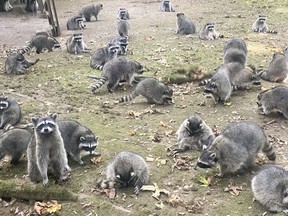
The same researchers are going to look at armadillos and opossums next
Article content
Already comfortable around humans, could raccoons take the next step and become household pets?
Advertisement 2

Article content
Trash pandas appear to be adapting anatomically to live alongside humans leading to possible domestication, according to a study, reports discovermagazine.com.
Article content
Article content
Researchers at the University of Arkansas in Little Rock (UALR) researchers noticed anatomical changes in raccoons and wondered if these cute critters — widely regarded as outdoor pests in Toronto — could be undergoing a domestication process simply by spending so much time around people.
Smaller snouts
The first piece of evidence, according to the study published in Frontiers of Zoology, is urban raccoons have smaller snouts compared to their rural counterparts, which is similar to patterns seen in other domesticated species.
Researchers nearly 20,000 images of racoons from across the U.S. that were provided by citizen scientists and collected through iNaturalist.org.

Your Midday Sun
Article content
Advertisement 3
Article content
Like dogs which evolved from wolves, urban raccoons displayed shorter snouts than their rural cousins. But the real draw, is the easily accessible garbage in cities.
It’s all about the trash
“Trash is really the kickstarter,” said senior study author Raffaela Lesch, assistant professor of biology at the UALR, in a news statement.
“Wherever humans go, there is trash. Animals love our trash. It’s an easy source of food. All they have to do is endure our presence, not be aggressive, and then they can feast on anything we throw away.”
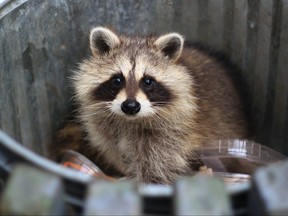
Researchers say many people think of domestication as a purely human-driven, “unnatural” process but animals can also adapt to people by seeking food and protection from predators.
Over time, these conditions can lead to traits associated with domestication. In order to survive with humans, animals can appear tamer and less fearful.
Advertisement 4
Article content
Floppy ears, smaller skulls
These theories line up with the Neural Crest Domestication Syndrome (NCDS) hypothesis, which suggests animals undergoing domestication show anatomical changes that begin early in embryonic development such as smaller skulls, floppy ears, pigmentation changes, and curly tails.
This study was done largely by 16 students under the supervision of their biology professor who wanted them more engaged in her biometry class.
Recommended video

We apologize, but this video has failed to load.
“I wanted to teach this class in a way that students would have their own data that they collect and analyze,” said Lesch.
“The benefit is that I didn’t have to push students to complete the work. They were intrinsically motivated because they cared.”
The researchers hope to study other urban mammals next such as armadillos and possums to see if similar domestication patterns are evident.
Article content
,
#pet #raccoon #study #day

0 Comments